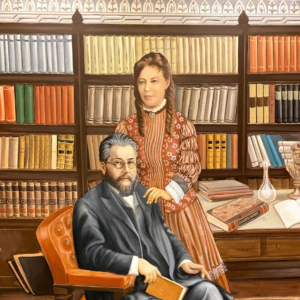
The ministry of GCBF carries on today a legacy that began with a simple act of obedience in Victorian London. In 1875, a woman confined to her home by illness did something small with what she had — and it grew into one of the most significant book distribution ministries in the history of the church. Her name was Susannah Spurgeon, and we’re grateful to walk in her footsteps.
Where It Began
In the summer of 1875, a woman confined to her home by serious illness changed the lives of thousands of pastors she would never meet.
Susannah Spurgeon — known to friends and family as Susie — is remembered today mostly as the wife of Charles Spurgeon, the great Victorian preacher. But Susie was far more than a famous man’s companion. She was a woman of deep faith, practical compassion, and remarkable ingenuity, whose quiet ministry from a sickroom left a mark on the church that endures to this day.
A Drawer Full of Possibility
It began simply. Charles had just completed the first volume of his Lectures to My Students, and Susie expressed her longing to place a copy in the hands of every minister in England. Her husband turned the wish back into a question: “Then why not do so — how much will you give?[1]“
She went upstairs and found in a drawer exactly enough money to purchase 100 copies.
That act of quiet obedience became the Book Fund — one of the most remarkable book distribution ministries in the history of the church. Susie could not have known it at the time. She simply did the next thing.
The Need She Saw
Spending long hours in her husband’s well-stocked study, Susie became acutely aware of a painful reality: the men shaping England’s Baptist congregations could barely afford to clothe their children, let alone fill their bookshelves. Many earned 60 to 80 pounds a year (Which is equivalent to 12-17 thousand dollars in today’s money) while raising families, paying medical bills, and carrying the full weight of pastoral ministry.
They were hungry for books. They simply could not afford them.
Applications to the Book Fund poured in from pastors across the country, each one a window into lives of faithful, under-resourced ministry. As one wrote to her:
“Through the long illness of my dear wife . . . I have been unable to add a single book to my very small stock for the last two years; therefore any present of a book is most thankfully accepted . . . May the Lord raise up many other friends, so that you may be able to help poor ministers yet more and more.[2]“
Susie answered every letter. She packed every parcel herself — seven or eight books at a time, along with sermons and donated stationery, and for the poorest pastors, copies of Charles’s magazine The Sword and the Trowel. In February of 1883 alone, she received 657 letters. Her husband occasionally had to intervene, placing what he called an “urgent veto” on the pace of her labor. She pressed on anyway.
The Joy of Her Life
What makes Susie’s story remarkable is not only the scale of what she accomplished, but the spirit in which she did it. She was often in pain. She was frequently exhausted. And yet she described the Book Fund with these words:
“The Book Fund is the joy of my life, and ever since the Lord gave the sweet service into my weak and unworthy hands He has led me by green pastures and beside still waters.[3]“
Charles himself saw it clearly. The Book Fund, he wrote, had “supplied my dear suffering companion with a happy work” and “relieved her weary hours and helped her to forget a portion of her pains.”
When Charles died in 1892, the grief was immense. Susie called it “the great separation.” But she did not stop. She turned back to the work — the letters, the parcels, the pastors waiting for books — and found in that faithfulness a kind of sustaining grace.
Over the 28 years Susie ran the Book Fund, nearly 200,000 books reached the hands of more than 25,000 ministers[4]. Hundreds of thousands of sermons were distributed around the world. She was meticulous, faithful, and utterly devoted to the conviction that a pastor with good books is a better shepherd — and that a better shepherd means a healthier flock.
A Legacy Worth Continuing
Susie Spurgeon did not set out to build a legacy. She found some money in a drawer and did something faithful with it. The Lord multiplied it beyond anything she could have imagined.
We think of her often at GCBF. The context has changed — the pastors we serve are not in Victorian England but in over 120 countries. The need, however, is the same. Faithful men and women, hungry for books, doing the work of ministry with whatever they have but hampered by what they do not have
Susie’s example reminds us that this work is worth doing, that it has always been worth doing, and that the Lord has a long history of taking small, obedient acts and multiplying them into something far greater.
[1] Susannah Spurgeon, Ten Years of My Life in the Service of the Book Fund: Being a Grateful Record of My Experience of the Lord’s Ways, and Work, and Wages (London: Passmore & Alabaster, 1886)
[2] Susannah Spurgeon, “Mrs. Spurgeon’s Book Fund,” The Sword and the Trowel (London: Passmore & Alabaster, 1876)
[3] Susannah Spurgeon, “Mrs. Spurgeon’s Book Fund,” The Sword and the Trowel (London: Passmore & Alabaster, 1876)
[4] Charles Ray, The Life of Susannah Spurgeon (London: Banner of Truth, 1995)
Stay close to the work
Stories, updates, and news from the field,
straight to your inbox.