Europe at a Glance
- Population: ~750 million (~10% of world population)
- Countries: 44
- Major Religions: Christianity (~72%) — Orthodox (~35%), Catholic (~28%), Protestant (~9%); Islam (~6%, growing); religiously unaffiliated (~19%); other (~3%). Eastern Europe is predominantly Orthodox; Western Europe predominantly Catholic and Protestant; the Balkans are a mix of Orthodox Christianity and Islam.
- Largest Cities: Moscow, Russia (12.5M) · Paris, France (11.4M) · London, UK (9.8M) · Madrid, Spain (6.8M) · Barcelona, Spain (5.6M) · Berlin, Germany (3.7M) · Rome, Italy (3.7M) · Bucharest, Romania (2.1M) · Warsaw, Poland (1.9M) · Belgrade, Serbia (1.3M)
- Major Languages:
- Russian — Russia, parts of Eastern Europe
- German — Germany, Austria, Switzerland
- French — France, Belgium, Switzerland
- English — UK, widely spoken across Europe
- Spanish — Spain
- Italian — Italy
- Polish — Poland
- Romanian — Romania, Moldova
- Serbo-Croatian — Serbia, Croatia, Bosnia, Montenegro
- Greek — Greece, Cyprus
- Turkish — Turkey, parts of the Balkans
Europe was once the thriving seat of Christianity and the birthplace of the Reformation. Its cathedrals, monasteries, and university faculties of theology stand as monuments to centuries of Christian thought and culture. But little has been left unchanged on the continent, including the spiritual condition of its people. Much of modern Europe has turned away from those roots and become deeply secularized and post-Christian. Each passing generation has less exposure to faith. Most Europeans today don’t find religion important or relevant enough to teach their children. Christianity has become, for many, merely another artifact of history.
Only about 10% of Europeans attend any kind of church weekly and in some countries the figure is far lower.
The numbers tell a sobering story. Only about 10% of Europeans attend any kind of church weekly — and in some countries the figure is far lower. Most Europeans identify as non-religious or atheist. Many have never met a genuine Christian. Post-Christian Europe may well be the most spiritually resistant mission field in the world — not because the gospel hasn’t been here, but because it has been here and largely abandoned.
Contributing to this spiritual complexity is the rapid growth of Islam through immigration and higher birth rates. Islam has become the second religion of Europe, and in several Balkan nations — Albania, Bosnia, Kosovo — it is already the majority faith. Many Muslims in Europe are searching for meaning and belonging, far from the violence and poverty of the countries they fled. Evangelical churches have demonstrated an outsize impact in these communities through effective social support and by bridging ethnic divisions.
Yet the picture is not without hope. While Orthodox and Catholic churches remain dominant, Protestant and evangelical communities are growing in several Eastern European countries, and Romania hosts one of Europe’s largest evangelical communities. Even amid overall population decline and erosion of Christian identification, evangelical and charismatic movements are growing in maturity, confidence, and identity. Likeminded churches and pastors across the region are building relationships, deepening theological commitments, and coming alongside one another in genuine partnership. These are modest gains — but they are real, and they are light in an otherwise bleak religious landscape.
The Balkans represent a particularly urgent and strategic field. Montenegro has 750,000 people and only around 250 known evangelicals. Kosovo has approximately 24 churches, 80% of which have no children’s or youth ministry — even as 70% of its population is under the age of 35. These are not post-Christian populations in the Western sense — many are encountering the gospel for the first time. Fruit is being found through friendship evangelism, compassion ministries, and intentional outreach among Roma communities, where real church growth is taking place.
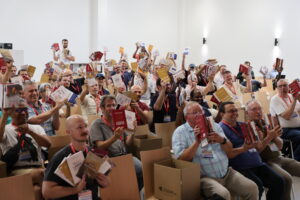
This is where Global Christian Book Fund focuses its work in Europe — resourcing church leaders throughout Europe with the theological tools they need to plant, strengthen, and sustain churches through the training of leaders in some of the continent’s most spiritually neglected corners.
Stories from Europe